Mandelbrot set explorer.
Start with z₀ = 0. Vary c. Follow the orbit.
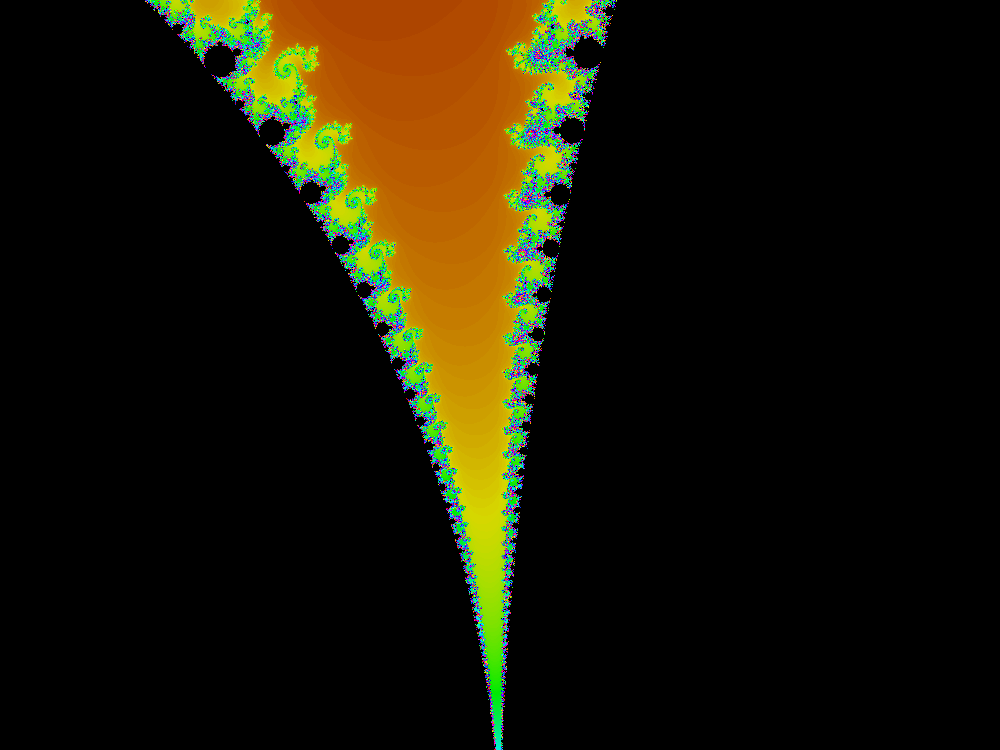
The interactive viewer loads here. Read the definitions and controls below, or open the study guide.
What is the Mandelbrot set?
The Mandelbrot set contains complex numbers c whose orbit stays bounded under zₙ₊₁ = zₙ² + c, starting from z₀ = 0. Each pixel is a different parameter. A Julia view fixes c and explores different starting values instead.
Mandelbrot Atlas turns this recurrence into an interactive study tool. The Java renderer calculates the pixels; you can inspect coordinates, record an orbit and compare the result with a proof.
Choose a coordinate
In Render, enter the real and imaginary parts and choose Center Mandelbrot here or Generate Julia set. Inspect also lets you trace a point or turn it into a Julia parameter. You can also place a marker directly on the image.
Mandelbrot vs Julia, explained ↗Move through the plane
Drag to pan, scroll to zoom, or double-left-click to zoom in. Double-right-click zooms out. Focus the viewer for arrow-key movement, + / − zoom and Home to reset. Escape exits fullscreen.
All controls and questions ↗Capture the detail
Explore at 200 Mandelbrot iterations or 1,000 Julia iterations. Julia previews can be adjusted from 10 to 10,000. Resolution changes the number of sampled pixels; iterations change how long each orbit is tested. Use Capture for a detailed PNG once the view is settled.
Choose iterations and resolution ↗Go beyond the picture
A non-escaping pixel is a finite observation. The eight source proofs and their expanded explanations connect the image to escape bounds, complex arithmetic and screen coordinates.
Read the proofs and handbook ↗Mandelbrot coordinates and their Julia sets
Open an example in the Mandelbrot viewer or generate a Julia set using the same complex parameter. In Inspect, trace z₀ = 0 to compare the Java result with the exact orbits below. An exact repeating orbit proves boundedness; a black pixel alone does not.
c = 0: a fixed point
0 → 0 → 0 → …
Starting at z₀ = 0, every step stays zero. This proves that c = 0 belongs to the Mandelbrot set. For the corresponding Julia view, points inside the unit circle approach zero; points outside it escape.
c = −1: a period-two orbit
0 → −1 → 0 → −1 → …
The orbit repeats two values, so it stays bounded forever. This proves that c = −1 belongs to the Mandelbrot set. Compare its Julia picture with the circular c = 0 example.
c = 1: an escaping orbit
0 → 1 → 2 → 5 → 26 → …
The orbit reaches 5 and grows without bound. This proves that c = 1 is outside the Mandelbrot set. In its Julia view, z₀ = 0 escapes too; other starting values must be tested separately.
The explorer uses finite precision and iteration limits. Any finite Julia parameter is accepted; outside |c| ≤ 2 the Java backend extends the original recurrence with a general escape bound. Read the escape-test assumptions.